


I hope you enjoy this issue of Between the Layers! Share it with your friends.
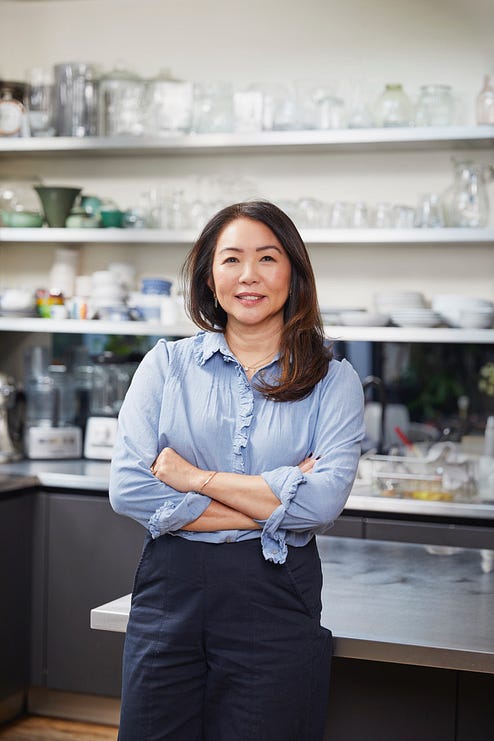
ORANGE CAKE HAS ALWAYS GOTTEN MY ATTENTION. Up against fruitcake and chocolate cake at Christmas, orange cake has held its own. And in the late 1960s an avant garde orange cake piqued everyone’s curiosity. It was the whole-orange-in-the-cake recipe popularized by British food writer Claudia Roden. Roden wrote A Book of Middle Eastern Food (Knopf, 1968), which was the first time anyone had really thought about adding a whole orange—rind and all—to a cake. So when I flipped through London pastry chef Helen Goh’s gorgeous new cookbook, Baking & the Meaning of Life (Abrams), to no surprise I was preheating the oven for her Favorite Orange Cake. A trained psychologist who collaborated with superstar London chef Yotam Ottolenghi for 10 years on nine restaurants and two award-winning cookbooks called Sweet and Comfort, Helen has now written her first solo book. She blends her baking know-how and her degrees in psychology to give us, the reader, not only beautiful, unusual recipes for cakes, pies, treats, and breads, but deeper context into how baking makes our lives richer. Her orange cake falls in the chapter called “Remembering & Continuity,” because she once baked it daily at a cafe in Melbourne, Australia. It is dense and moist from the peel and juice of the orange, and to Helen, “it’s perfect to bring along when visiting friends.” Each chapter in Helen’s book illustrates a way that baking improves our lives. These chapters include not just Remembering, but also Giving, Receiving and Sharing. Nurturing. Celebrating. Community & Belonging. Ritual & Tradition. And Learning, Growth & Achievement. When you stop and think about it, what we bake and why we bake falls into one or many of these categories. Helen Goh just took the time to think and write about it.
Born second-generation Chinese in Malaysia, Helen was raised in Melbourne, Australia, where her parents thought she and her four siblings would find better educational opportunities. It wasn’t easy uprooting their family and moving to a place where her mother would find the English language difficult. “She started as a seamstress at quite a young age, having left school after her father died because the family needed money,” Helen said. “My father was an up-and-coming businessman, having also left school at a very young age for the same reason, but managed to make his way in the world. He needed business suits and my mother was his tailor.” When the family moved to Australia when Helen was 11, cooking was her mother’s “way of showing she was a competent person.” Helen’s life would flourish in Australia, with a university bachelor’s degree in science and a master’s in psychology, and when her professors said she was too young to get a job in the field right out of school, she worked briefly for a German pharmaceutical company. Which is where she found more pleasure planning the doctors’ lunch menus than talking to them about the drugs she represented. “I saw it as a sign,” Helen said. She dabbled in the restaurant world, opening a cafe with a friend and learning to bake from the cooks they hired. In the end, she followed a boyfriend to London, married him, and started her own family. Her two sons are now nearly 15 and 11. New in London, Helen needed to wait four months before she could begin doctoral work in psychology. So to pass the time, she applied for a job to work on recipes with Yotam Ottolenghi, an up-and-coming talented Israeli-British chef who was opening a new cafe. Theirs became a symbiotic relationship—she learned Mediterranean and Middle Eastern cooking and baking from Ottolenghi. And Helen brought a diligence and deep love of baking that came to define Ottolenghi’s recipes in restaurants and bestselling cookbooks. Helen knew the power food has to bring people together. She has one brother and three sisters who still live in Melbourne. They are a typical Chinese-Malaysian family—“tight-knit and full of drama and misunderstandings and cultural clashes with extended family!”
Last week, Helen and I Zoomed early in my morning and midday in hers from London. Dressed in bright red, with an even brighter smile, she was in the middle of writing one of her food columns for the Guardian (London) and the Sydney Morning Herald (Australia). It was a Mother’s Day-themed recipe and she wanted to use raspberries but was in a quandary about whether the berries should be fresh or frozen. When you write for audiences in different hemispheres, she said, these are things you must consider. Anne: Helen, why this book now? Helen: The Ottolenghi concept as I learned it is outward looking. Cakes have got to look nice in the window. You have a customer to appeal to. But I wondered what about the small inward moments of baking, those moments when I think about cakes and who they are meant for. Anne: What do you say to people who remark, I don’t bake. Are they missing something in life? Or is everyone just not cut out to be a baker? Helen: I hear many people say baking is their therapy or their nemesis. Baking requires a kind of focus and attunement that takes you away from white noise in the head, a worry that you’ve said something wrong the day before, that sort of thing. But for the person who finds it stressful to follow the rules of a recipe or focus, well, baking isn’t something they might enjoy. You can talk to your mother on the phone and cook onions, but try to weigh flour and talk to someone at the same time! Anne: How is restaurant baking different than what we do at home? Helen: At a restaurant you can put carrot cake on the menu. It would be loaded with flavor and texture and be homespun. But there is pressure in restaurants to be seen as being clever because it’s competitive. With Ottolenghi, if we put the cake out there we must seduce from the window with color and visual appeal. I am less attentive to that when I’m baking at home. When I bake a chiffon cake at home I don’t want a buttercream on top, but that wouldn’t sell at Ottolenghi. Home baking isn’t competitive. It’s where baked things just need to taste good. Anne: What flavors do you feel are fashionable in baking right now? Helen: In Australia, certainly Korean, Japanese, and fusion baking. New colors, new flavors. Purple yams, pumpkin cakes, chocolate chip cookies with glutinous rice flour to make them chewy. Here in London, using Japanese milk bread to make French toast is smart because you introduce something new to something known.
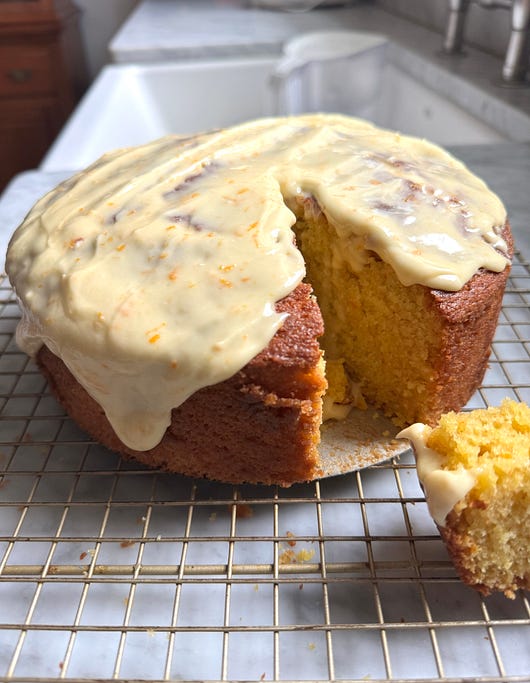
Anne: Many people might call your decade of experience with Ottolenghi as a lucky break. But as a trained psychologist, what do you call this? Helen: I got my doctorate in existential psychology, which is how to make the best of your choices in life. We all make little choices in life and they add up. Ordinary moments add up to an extraordinary life. Ottolenghi was an amazing experience for me, but now I’m focusing on my interior life and what baking says about me. Helen’s book was originally published in the United Kingdom and Australia. For the American edition published by Abram’s, Helen worked with a San Francisco recipe tester who converted recipes with self-raising flour to all-purpose, adding the appropriate leavening. Having lived and baked in England, I can say that American flour is different than what’s available in the UK, and so are the baking pans. I brought back with me deep 8-inch cake pans that are more like a springform pan, and they have removable bottoms so getting the cake out of the pan is simpler. I used this pan to bake Helen’s orange cake, and it was perfect. But I realize not everyone has this pan. So if you have a springform pan, use it in the orange cake recipe. Or portion the batter into two 8-inch regular cake layers and bake a little less time for a layer cake. You can even bake this cake in a 13- by 9-inch pan. I love this orange cake, and its texture is even nicer the next day. Dollop the frosting onto a cooled cake, or if you’d like more of a glazed look, spread it on while warm, which is what I did after snapping the photo. Helen admits she’s having a little trouble perfecting this cake in London. It always worked in Melbourne. Well, it worked in Nashville, too. Hope you enjoy a beautiful cake from a beautiful person. Thank you, Helen! - xo, Anne P.S. What a crazy week! I will have been in Richmond, Virginia; Monroeville and Mobile, Alabama; and Tallahassee, Florida with book events by the time this newsletter is published. My schedule is nothing to compare with the chilling, rapid-fire news of the day, however. When I left home, the drama was circling around the USA men and women’s gold-medal winning hockey teams, and always I am impressed with the grace and grit demonstrated by Katie Couric. Go Katie! And now a war in Iran? What happened to bringing down the price of eggs? And where the heck is Congress?
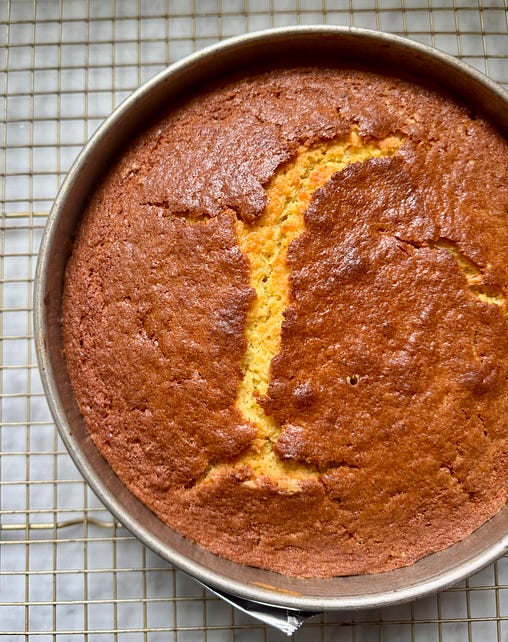
THE RECIPE: Helen Goh’s Favorite Orange CakeLove this recipe and you will, too. You need to find the right pan in which to bake it, which means the pan is deep enough for all the batter. If you have an 8- or 9-inch springform, this will work. While the recipe says the cake will be done in one hour, it took 20 minutes more for me. Baking at 375ºF will cause the top of the cake to brown, which I loved. If you don’t, tent it with aluminum foil once it gets to the color you prefer. I used a big naval orange in this recipe, and it was perfect. Just the right size, plus it felt heavy in the hand, which means lots of juice. I scrubbed it well knowing I was going to eat the entire orange! After the orange cooked, I trimmed off the stem end and the navel-y end before pureeing. Needless to say, you must use a seedless orange in this recipe, too. When I bake this cake again, I might reduce the baking soda to 1/4 teaspoon, and I might try it in a sheet pan because I will pour the frosting over the cake while it’s still in the pan and hot so it forms a glaze! Makes 12 servings Bake: 1 hour, 20 minutes, or until done
You’re on the free list for Anne Byrn: Between the Layers. If you’re liking what you’re reading, why don’t you become a paying subscriber for more recipes, stories, and content.
|








0 comments:
Post a Comment