


I hope you enjoy this issue of Between the Layers! Share it with your friends. Baking Cookies with David Lebovitz - No. 369A gingery gingerbread cookie + how to make your own candied ginger from the Paris-American food phenom
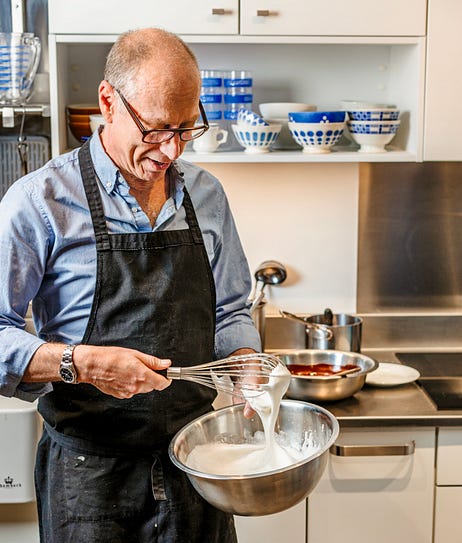
IN THE WORLD OF FOOD WRITING, some people cook, some people write, and some folks do both. I can spot the latter just by reading a great recipe headnote—the little paragraph or two that precedes the recipe. It’s supposed to get you in the mood to make the recipe, deepen its context, and share critical details for the recipe’s success. A great food writer will inject some personality when allowed. (In online newsletter writing all personality is allowed, but in the world of cookbooks where paper costs money, editors often slice and dice words to fit it on one page. Which leaves recipe headnotes—my favorite part—dead boring.) But when I read David Lebovitz who writes from his Paris kitchen on Substack and is no newcomer—he has written a successful cooking and baking blog since 1999 and nine cookbooks, the most recent, Ready for Dessert—I am reassured all is well in the food writing sphere. David is frank, funny, on point, a perfectionist, and enjoys cooking and baking as much as he does writing about it. He isn’t afraid to let that seep into his words. So his readers, including myself, feel like we know him even when we’ve never met him. I decided to take this one step further and reach out to David via email about his latest book hoping to start a conversation about cookies.
A native of Connecticut with busy parents (a lawyer father and artist mother), his was not a food-centric family, David told Substack’s Susan Herrmann Loomis this past summer. “Mom came home after work and rifled through her recipe box to pull out a recipe like chicken cacciatore. She wasn’t a creative cook, but she was a good one.” He was a film major at Ithaca College in upstate New York and worked in a vegetarian restaurant, loving the adrenalin rush of the restaurant world. After college, he heard about Alice Waters embracing cooking with such seasonality at Chez Panisse restaurant in Berkeley, California, that, according to the New York Times, he moved to San Francisco “without a job offer or even an exploratory phone call.” He was turned away at Chez Panisse but Judy Rodgers hired him at Zuni Cafe. When Chez Panisse gained an international following, Waters expanded and opened Cafe Fanny upstairs, which is where David was hired as a line cook and there he learned the art of pastry from the legend Lindsey Shere. When David moved to Paris in 2003 to join his partner, the artist Romain Pellas, it was a cultural adjustment. Writing in his newsletter, “the top of my dishwasher doubled as a kitchen counter…I tried living without an electric stand mixer, due to lack of space, but finally caved and got one—followed by an ice cream maker.” He’s now in a larger kitchen in an apartment in the 11th arrondissement, where David writes about what’s in season in nearby markets, his travels (most recently Japan), and what he’s eating and drinking, delighting his Substack readers and his robust following on Instagram. I caught up with David just a week after his return from Japan. I had sent him some questions about cookies and was hoping he could answer them quickly, but when I got his thorough answers it was evident he doesn’t do anything half well.
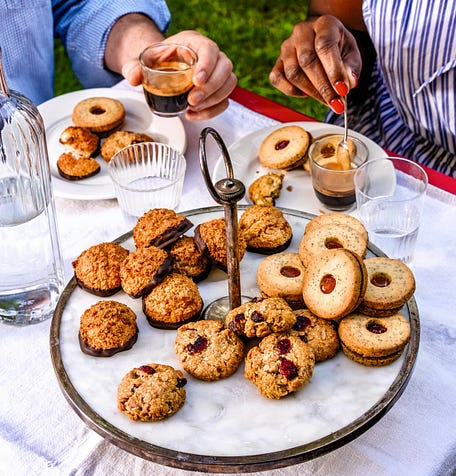
A Cookie Q&A with David LebovitzAnne: Are your favorite cookies more attached to a professional kitchen in which you’ve worked or to a home kitchen? David: I’ve been a professional cook and baker most of my life, and I’ve had more experience in restaurant kitchens, so I’m going to say a professional kitchen. Apollonia Poilâne, who owns the famous Poilâne bakery in Paris, once told me, “Bread likes to be baked together,” which helped me understand why I was never drawn to baking bread at home. Who wants to separate things that prefer to be together? Although I can’t say I have any firm proof of it, I think cookies like being baked together too, with lots of other cookies around them. (And if you think about it, the idea of just one cookie baking is rather sad.) Anne: What do cookies need most? Consistency? Whim? The ability to use what you’ve got? Or the very best ingredients? David: More than anything else, cookies need to be watched like a hawk. One minute can be the difference between soft and chewy, and hard and crumbly. More than almost any other baked good—such as a cake, pie, or tart—the timing on cookies is critical, but I tell people to use the visual and tactile clues (which I give in recipes) and use the baking times as guidance, as ovens can differ. Anne: Do you prefer cookies large or small? Chocolate or spice? What is your favorite cookie? David: I like both large and small, but I can say that I’m not a fan of those XXL cookies. I think they’re too much of a good thing. My favorite cookies are chocolate chip cookies, especially when they’re loaded with melting chunks of chocolate and crisp, toasted nuts.“ Anne: When do you like to eat cookies? David: My favorite time to eat a cookie is just after I get up in the morning. Even before I make my coffee, if there is a plate or container of cookies around, I will eat half of one right away… then the rest while the coffee is brewing.
Anne: Are there cookies you associate with December? David: Although in France spices like cinnamon, ginger, and nutmeg aren’t used as heavily as they are in the U.S., I’d say gingersnaps are what I crave in the winter. Anne: I appreciate how you’ve included buckwheat with chocolate. Are home bakers missing something by not experimenting with new flours? David: I love the flavor different flours give to desserts, but I’m especially smitten with buckwheat, which lends a rich, earthy flavor to desserts, such as my buckwheat chocolate chip cookies…I’m also a fan of spelt flour, which is made from a type of wheat, but it’s nuttier and closer to whole-wheat flour. I sometimes swap out some all-purpose flour in a cake recipe with the same amount of spelt flour to give a cake a bit more of a hearty flavor. Whole-wheat flour, I think, got a bum rap back in the ’70s and ’80s, when people who were part of the natural food movement of that era would make desserts using only whole-wheat flour, and the results could be dry, leaden, and crumbly... I even add a bit to croissants, which heightens the flavor of the wheat and makes the croissants a little more wholesome (and probably closer to their original flavor, from when wheat wasn’t as refined as it is today). Anne: What ingredient do you splurge on? Where do you save money? David: I splurge on cocoa powder. When you bake a cake with dark chocolate, the difference is less apparent than when you bake with cocoa powder. I’m not a fan of calling for specific brands in recipes, but I’ve found that good cocoa powder is worth calling out—and worth the extra expense. (I favor Valrhona and Cacao Barry Extra Brut, the latter of which is only available in 1-kilo/2.2-pound bags; I use a lot of cocoa powder, but home bakers can share a bag with a friend if that’s too much.) I also love good vanilla, and I was friends with a vanilla expert and importer who turned me on to Mexican vanilla—the real stuff, not the cheap quart bottles sold to tourists—and I’m a fan of that, although that’s another splurge. Otherwise, I tend not to use expensive products when I bake, especially when writing recipes for home bakers, since I like to keep my recipes accessible to as many people as possible. Where I save money is buying butter in bulk. I stock up on it when I see it on sale and freeze it. Anne: Revisiting old recipes. Do you enjoy it? David: When I had my blog, from 1999 to 2020 (when I started my newsletter), I was sharing a lot of recipes, constantly developing and publishing them. Unlike books, on a website you can change things, and I’d go back and look at something I’d made fifteen years before and say to myself, “Wait. That was interesting, but how about if I added ______ to the batter?” Or often, after making a recipe over and over, it would occur to me that there was a different—and easier—way to do something, so I’d update it. It can become an obsession to go back and revisit and revise recipes, but I always say that recipes aren’t set in stone. If they were, cookbooks would be very, very heavy. Anne: You say there are soft-cookie people and crunchy-cookie people. Which are you? David: I think if I were faced with two plates of cookies, I’d reach for the soft ones first. Me, too. How about you? Would you reach for the crisp or soft cookie?
Thank you, David, for taking the time to talk cookies with me! Here is how to find David Lebovitz on Substack: Happy Baking! - xo, Anne P.S. I agree about watching the baking time of cookies carefully. Bake one pan at a time in the beginning to get the timing or size of the cookie right. If the cookies seem too small or overcooked, adjust for the next round. I couldn’t fit everything I learned into our Q&A so here are other things I gleaned from Ready for Dessert, which is a revised edition of his 2012 book of the same name:
Dunk, Drizzle, Sift: 3 easy ways to dress up holiday cookies
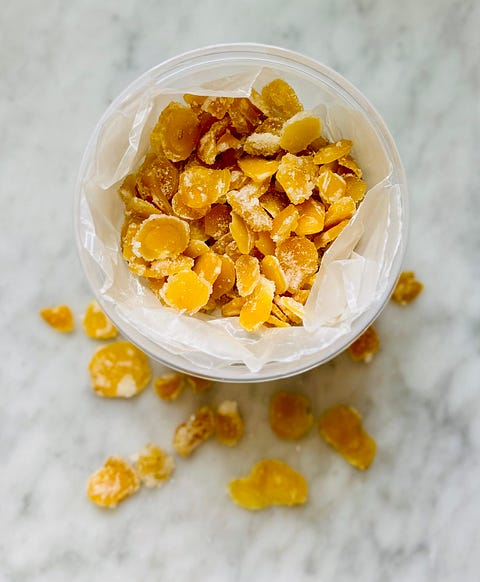
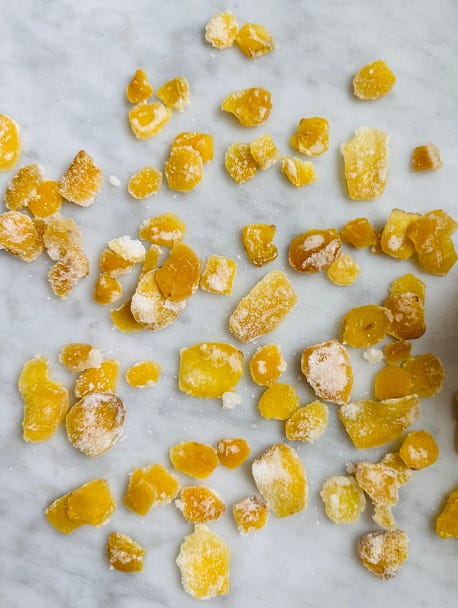
THE RECIPES: David Lebovitz’s Candied GingerThis keeps in an airtight container for months. Chop and add to baked goods or just eat! David peels the skin from ginger with the round end of a soup spoon, which is a clever trick. Find your sharpest paring knife so you can slice the peeled ginger crosswise, against the fibers. The recipe calls for a tablespoon of light corn syrup, which is optional, he says. Reserve the syrup for sweetening iced tea or making holiday drinks. Makes about 2 cups
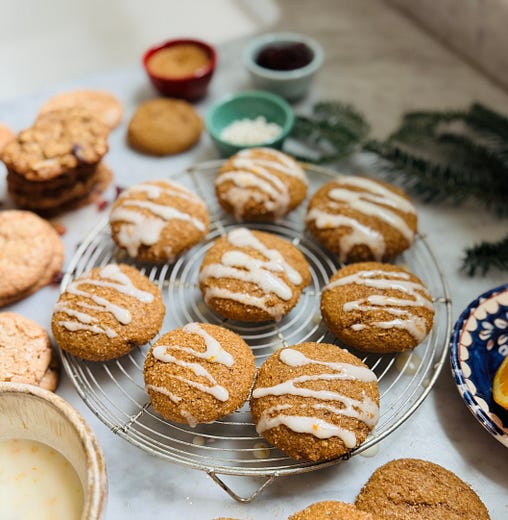
David Lebovitz’s Nonfat GingersnapsThe inspiration for this recipe came from a natural foods store in San Francisco, but when no one would share the recipe, David came up with his own. These are much better than the name implies. They don’t contain any butter or oil, and only the whites of eggs and no yolks, so thus the name. But they are packed with flavor from the candied fresh ginger and also spices. I used Kentucky sorghum in this recipe, but you can reach for molasses. They’re chewy and good keepers and great for breakfast! How you roll the balls of dough in sugar is up to you—David uses granulated sugar but I like the coarse sugar for extra texture. And he has a good suggestion: Save some cookies to make ice cream sandwiches and fill with lemon frozen yogurt or just vanilla ice cream. Makes about 2 dozen cookies
You’re on the free list for Anne Byrn: Between the Layers. If you’re liking what you’re reading, why don’t you become a paying subscriber for more recipes, stories, and content.
|








0 comments:
Post a Comment